
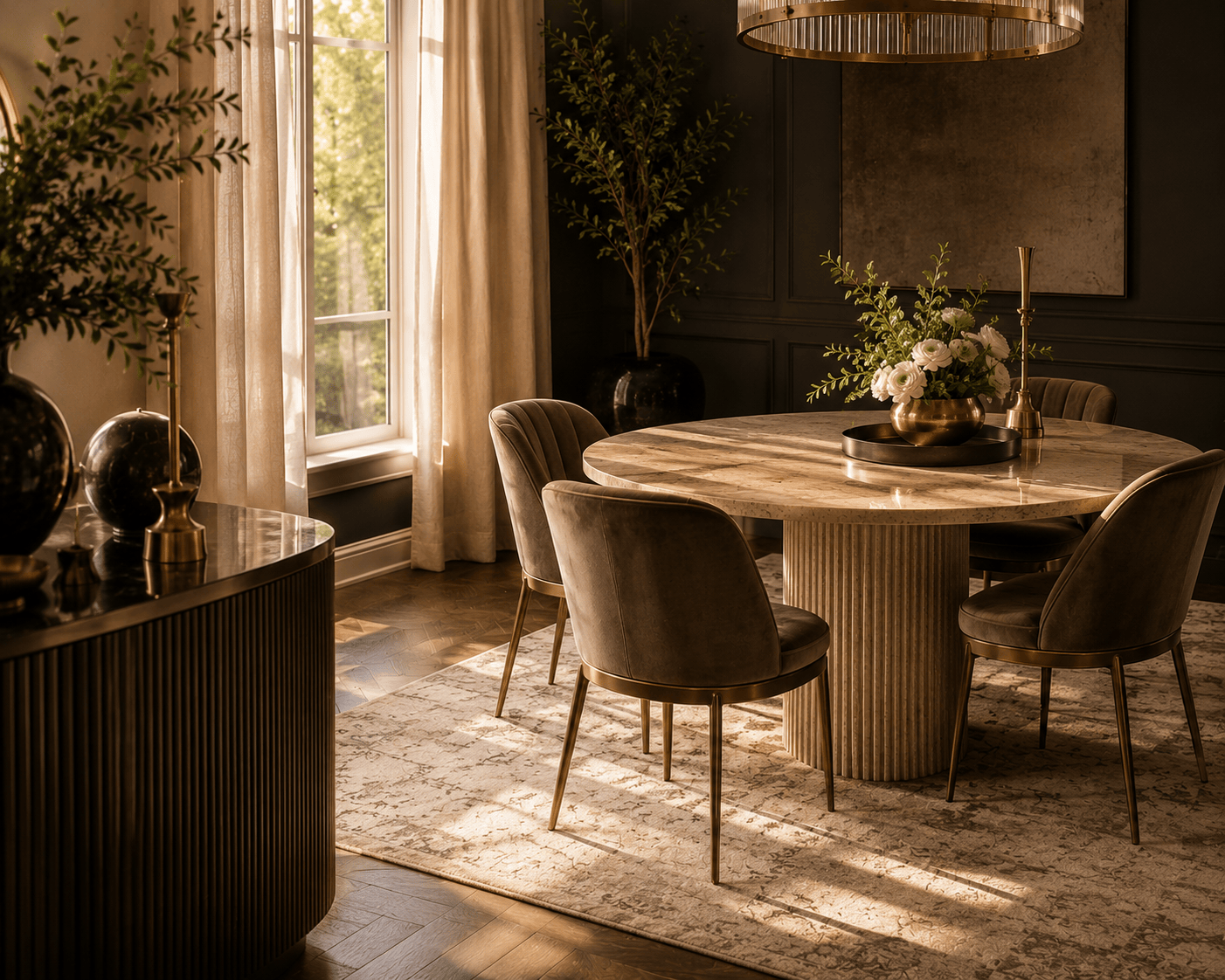
A Neo Deco dining room works when the room feels collected rather than decorated all at once. Start with one strong anchor, then let the chairs, lighting, sideboard and tablescape support it. The goal is a dining room with real presence that still feels comfortable enough to use every day.
The Anchor Piece: A Table That Can Carry the Whole Room
Shop the Meridian Furniture Genoa Art Deco Dining Table, Travertine Top on Amazon →
Before you think about chairs or chandeliers, get the table right — it’s doing more visual work than anything else in the room. A round table like the Meridian Furniture Genoa travertine dining table reads Deco instantly because of what it doesn’t have: no boxy apron, no four straight legs fighting for attention, just a clean pedestal and a stone top with the kind of soft, cloudy veining that photographs beautifully in low light. Travertine specifically is the move here over a glossy lacquer or mirrored top, because it keeps the room warm instead of tipping into hotel-lobby territory. Get the anchor piece right and you’ve already solved half the room’s attitude before you’ve hung a single light.
Scale is where most people get tripped up, so measure twice: a 48-inch round table needs roughly 8 feet of clear diameter in the room once chairs are pulled out, so this size suits a true dining room more than a tight breakfast nook. Because it’s round with a pedestal base, you get real legroom for every seat and better sightlines across the table for conversation, which matters more than an extra 10 inches of surface area. Let the table’s warm stone tone set the palette for everything above it — the chandelier’s brass, the chair velvet, even the wall color — instead of picking those pieces first and hoping they match later. This is the piece worth spending your budget on; everything else can flex around it.
Look for: a pedestal or plinth base instead of four straight legs, a natural stone or stone-look top for the right soft sheen, and a diameter that leaves at least 36 inches of clearance to the nearest wall on every side.
Seating With Curves: Chairs That Earn Their Silhouette
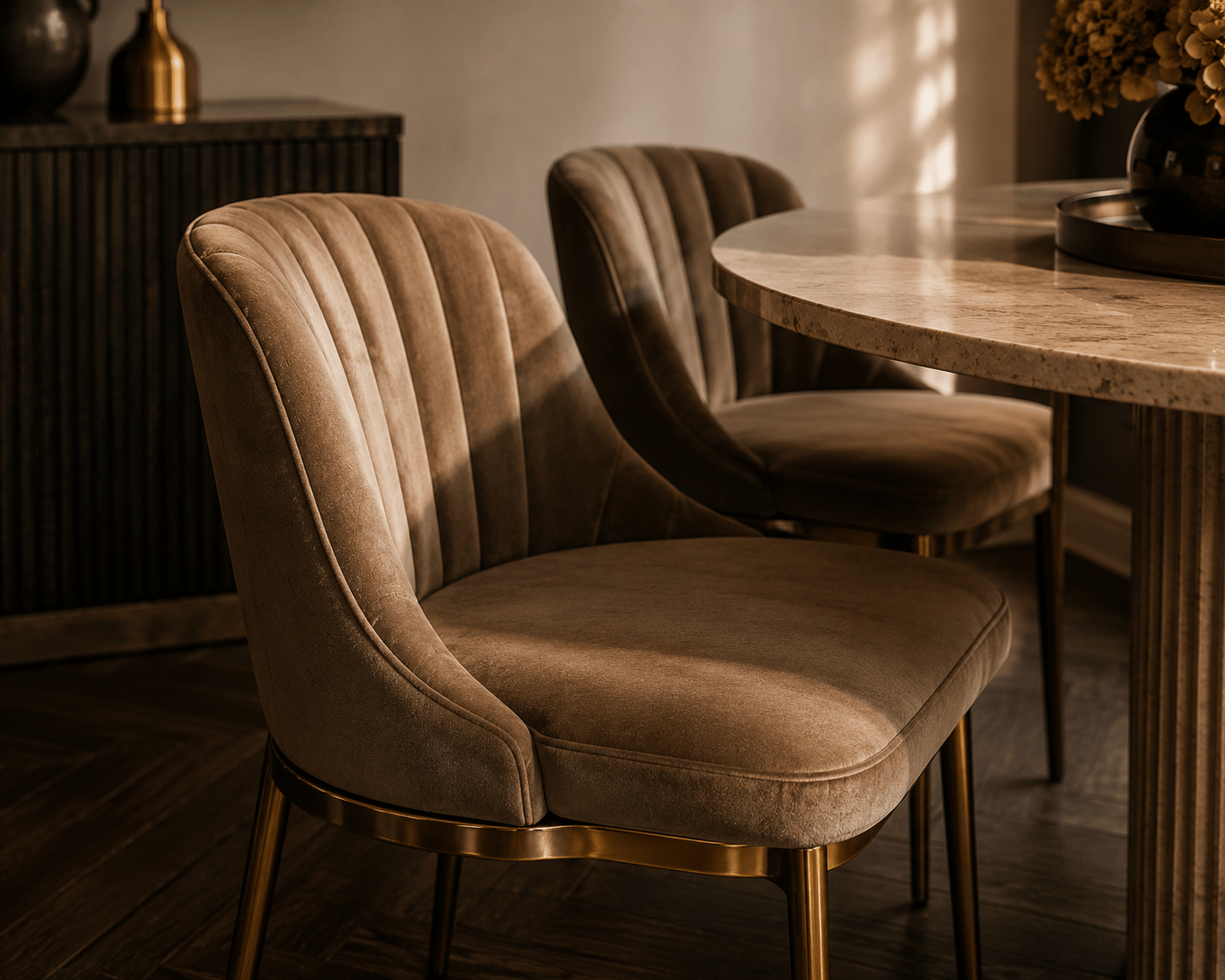
Shop the FRITHJILL Art Deco Velvet Dining Chairs, Set of 2 on Amazon →
Chairs are where Deco either sings or goes flat, because a straight-backed chair makes even a beautiful table look like it’s on loan from a conference room. What you want is curve — a rounded or tufted back that catches shadow, the way the FRITHJILL velvet dining chairs do with their tufted backrest and solid wood frame. Velvet in particular earns its keep here: it softens all that stone and brass with something you actually want to touch, and it photographs with a depth that flat linen or faux leather just can’t match. Pick a chair with presence, not just a chair that fits under the table.
You don’t need a dramatic color to get the effect — a warm neutral velvet like beige or oatmeal does the job just as well as a jewel tone, and it’s far easier to live with day to day. Repetition is what sells the look, so let the same chair silhouette run all the way around the table rather than mixing four different styles. A solid wood frame under the upholstery matters more than people think, since it’s what keeps the chair from wobbling within a year of regular dinners. Sit in it before you commit to the whole set — a chair that looks stunning but isn’t comfortable for an hour-long dinner will get quietly retired to a bedroom corner.
Look for: a solid wood (not particle board) frame, a tufted or channel-back detail for shadow and movement, and a performance-grade or high-rub-count velvet if the chairs will see daily use.
The Chandelier Is Jewelry: Let the Lighting Do the Talking
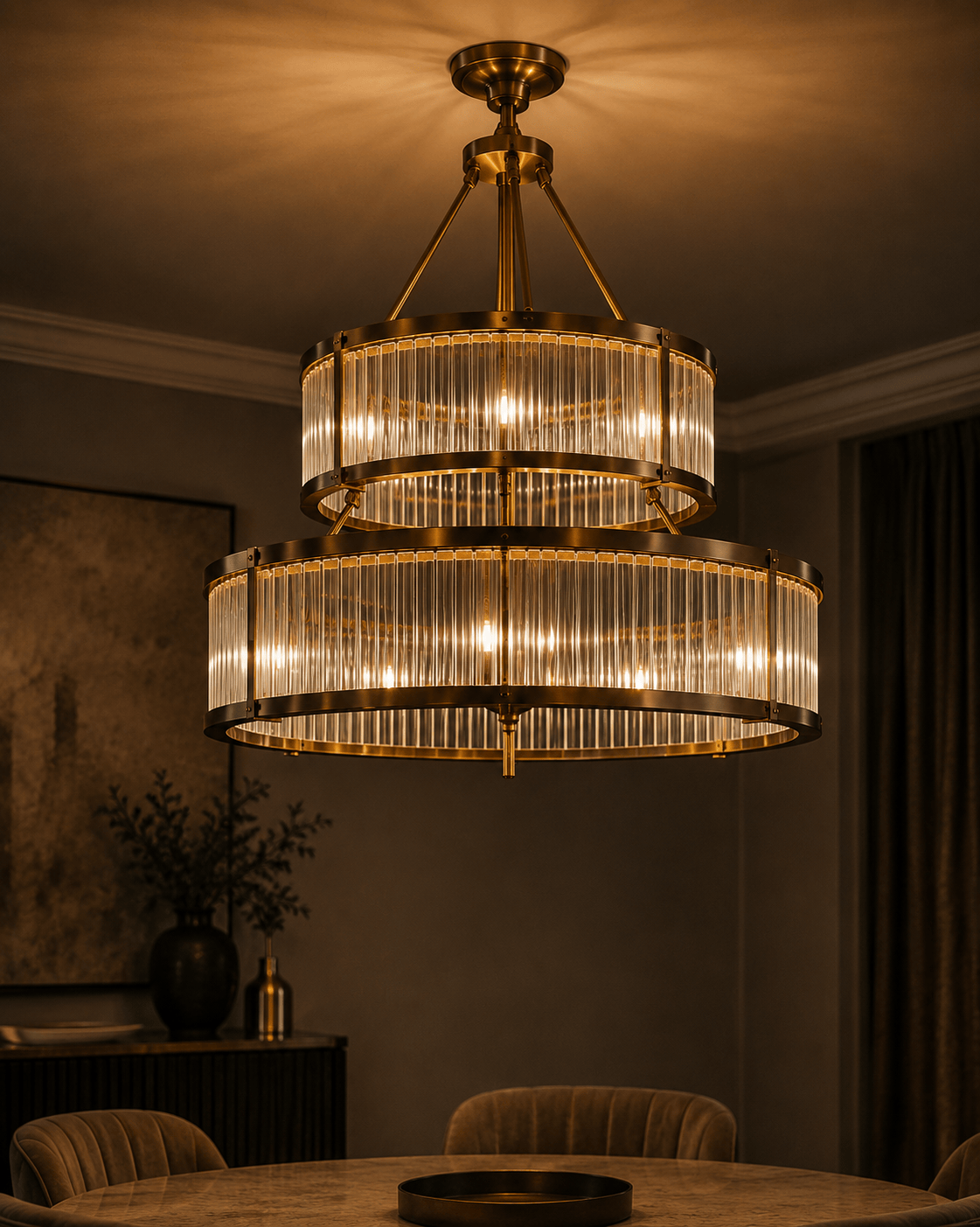
Shop the Tinkoso 26" Gold Vintage Art Deco Chandelier on Amazon →
If the table is the outfit, the chandelier is the jewelry — it’s the one piece people notice before they even sit down. A two-tier gold fixture like the Tinkoso chandelier gives you the layered, sculptural silhouette that makes a dining room feel finished rather than furnished, especially hanging above a stone table where the metal and the mineral play off each other. Nine lights sounds like a lot, but tiered fixtures like this one are meant to be dimmed low for dinner, not run at full brightness, so you’re buying flexibility as much as drama.
A dimmer switch is genuinely non-negotiable — without one, even the most beautiful chandelier reads harsh and flat. Bulb temperature matters just as much as the fixture itself, so stick to warm white in the 2700K–3000K range; anything cooler will fight the brass and make skin tones look tired at the table. Hang the fixture so its lowest point sits about 30 to 34 inches above the tabletop, which keeps it out of eyeline while still reading as a real presence in the room.
Look for: warm-white bulbs (2700K–3000K) on a dimmer, a fixture that spans roughly half to two-thirds of your table’s width, and a bottom edge that hangs 30–34 inches above the tabletop.
The Sideboard Is a Supporting Actor, Not a Backup Table
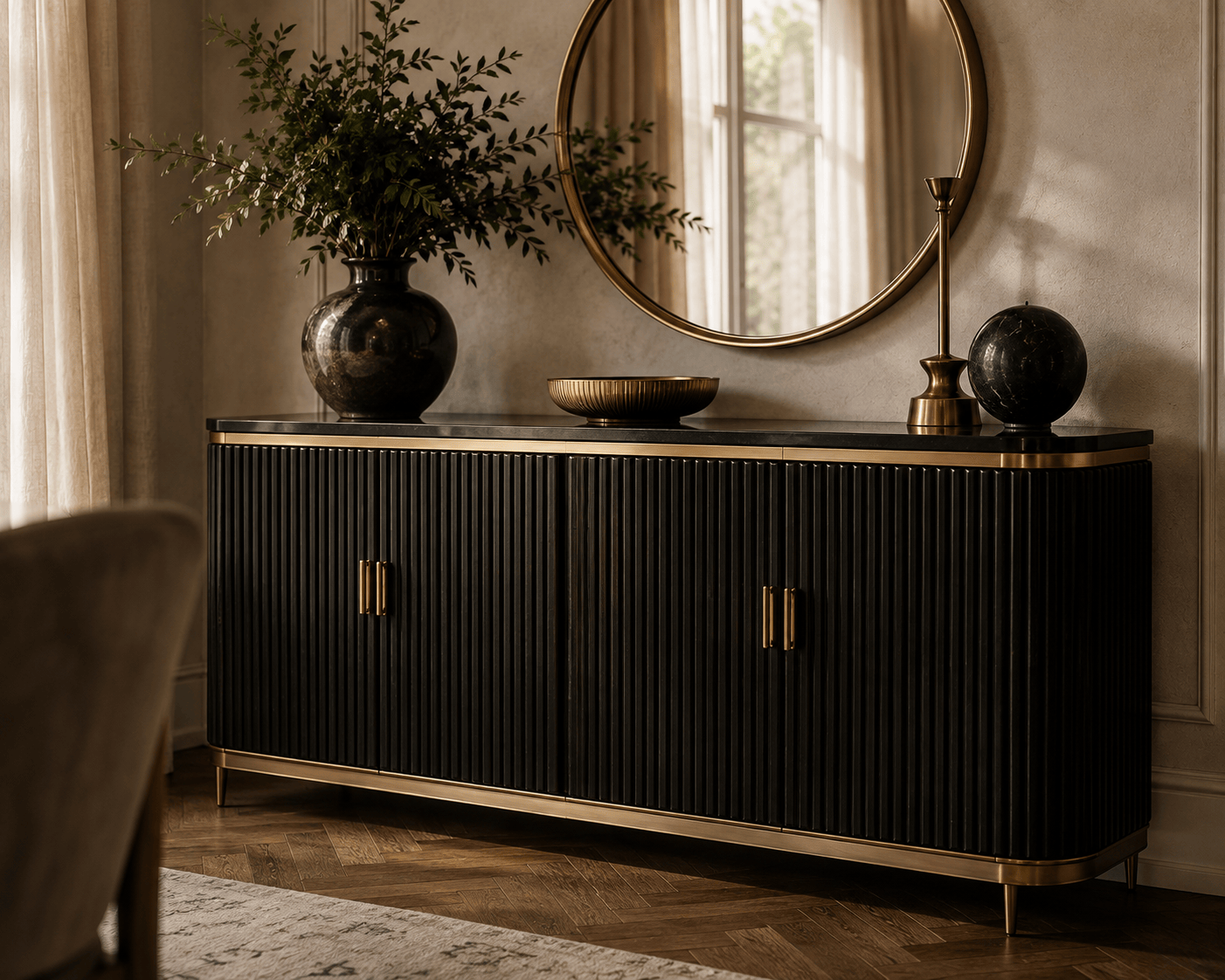
Shop the AUN Black Metal Sideboard Buffet with Art Deco Carving on Amazon →
A sideboard has one job that’s easy to forget: it’s storage and display, not a landing pad for mail and stray keys. The AUN sideboard’s black cabinet with carved Art Deco fronts and gold hardware shows how this piece should behave — real texture and shine from across the room, but staying in a supporting role instead of competing with the table for attention. That contrast between the matte black body and warm gold pulls is exactly the ink-and-brass combination that makes a Deco room feel cohesive rather than themed.
Style the top with restraint: leave at least two-thirds of the surface visually empty, then group what’s left in odd numbers — a mirror or art leaning above, a low bowl, one plant with some height. Scale the art or mirror above to roughly two-thirds the width of the sideboard itself, or it will look like it’s floating above a piece of furniture it doesn’t belong to. Depth matters too — anything more than about 20 inches deep starts eating into the walking path in an average dining room.
Look for: gold or brass hardware with a warm, not overly yellow, finish; carved or fluted door fronts for texture; and a depth around 18–20 inches so it doesn’t crowd the room’s walking path.
Tablescape Layers That Read as Curated, Not Catered
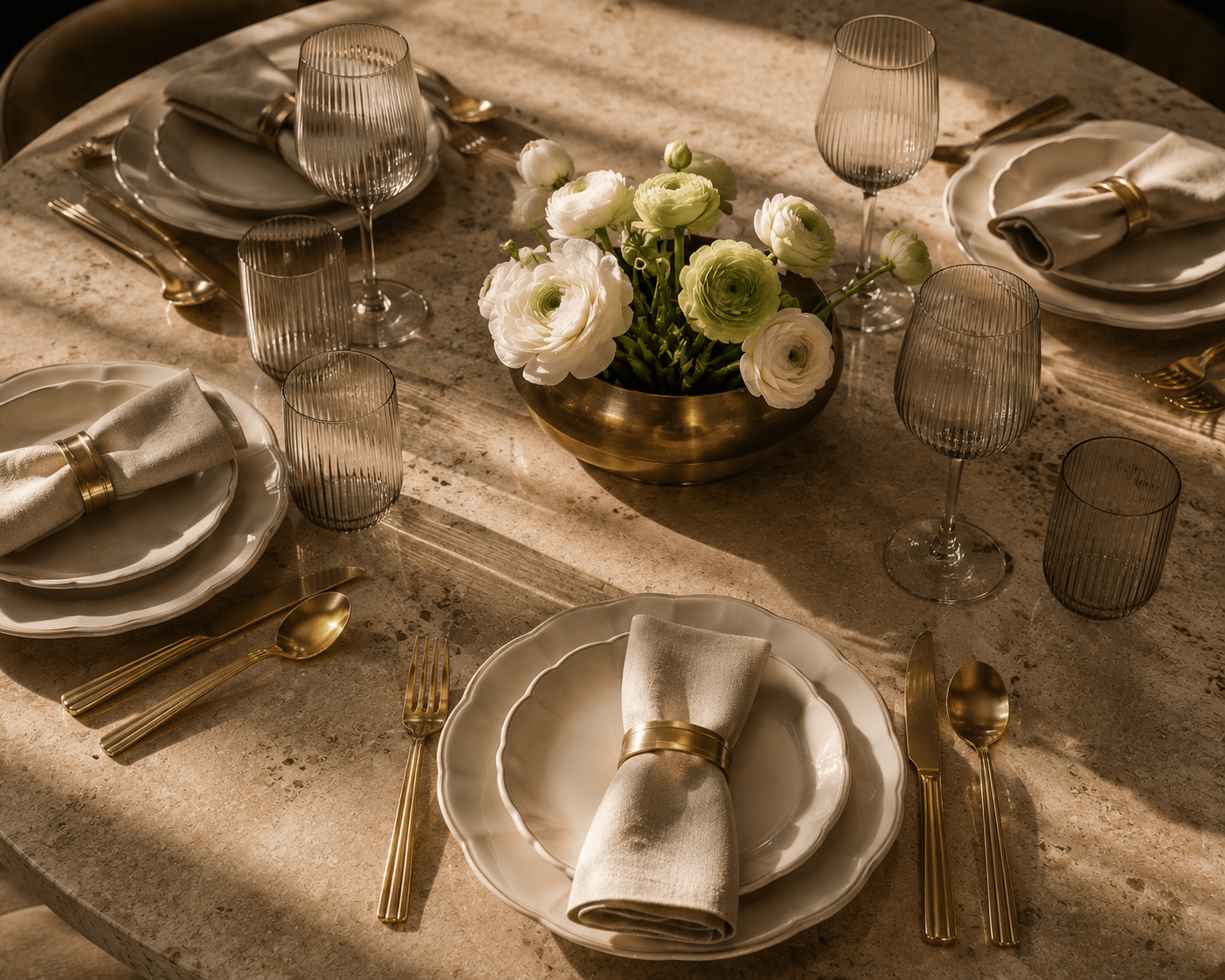
Shop the 24-Piece Gold Silverware Set, Mirror Polished on Amazon →
This is the layer people skip, and it’s the one that photographs the most: what actually sits on the table. A mirror-polished gold flatware set ties directly back into the brass in your chandelier and your sideboard hardware, so the whole room reads as one considered palette instead of three separate shopping trips. Gold flatware also picks up candlelight and warm bulb tones instead of going cool and flat under them. Buy a full set for the number of people you actually host regularly, not the largest set available.
The trick to a curated-not-catered table is restraint layered on restraint: a linen runner instead of a full tablecloth, one low centerpiece that doesn’t block sightlines, and glassware simple enough to let the flatware and stone tabletop do the talking. Mix your textures on purpose: a soft linen napkin against mirror-polished metal against a matte stone table is the kind of contrast that makes a table feel styled rather than assembled from a single catalog page.
Look for: a warm gold tone rather than a brassy yellow or pink-toned rose gold, a mirror-polish finish for maximum candlelight sparkle, and pieces with real weight and heft in the hand.
Museum or Home? The Rules That Keep It Feeling Lived-In
Shop the RUGWYN Handmade Oval Geometric Wool Area Rug on Amazon →
The “museum” feeling almost always comes down to the same culprit: too many hard, shiny surfaces and nothing soft to absorb the room. A handmade wool rug, especially an oval one like the RUGWYN geometric design, does more to fix that than any single piece of furniture, because it grounds the room underfoot and softens the echo that comes with stone, glass, and lacquer. The oval shape breaks up all the rectangles and straight lines from the table and walls, so the room reads considered instead of stiff.
Beyond the rug, a few rules keep this style livable: mix in at least one piece that isn’t brand new, let something sit slightly off-center or asymmetrical on purpose, and layer soft materials against every hard one — wool under stone, velvet against travertine, linen against gold. And finally, use the room; a table with a stack of mail on one corner and a candle burned halfway down will always beat a table that’s never been touched since the photo was taken.
Look for: a rug sized to extend 24–30 inches beyond the chairs on every side so they stay on the rug even when pulled out, a natural fiber like wool for texture and durability, and a pattern with movement rather than a rigid grid.
As an Amazon Associate I earn from qualifying purchases.
Leave a Reply